
I have often joked with friends and colleagues that if I ever ran for public office that my platform would consist of only two planks, both of them associated with the science and civilian discipline of timekeeping.
The first is one that I believe everyone has experience with and that most people are quite fed up with: the twice-per-year switch between standard and daylight savings time. The arguments are all quite familiar and I won’t rehash them here. I will simply say that we should pick one stick with it.
The second of the timekeeping policy items is known only to a very small percentage of people in the world: the leap second. A lead second is an extra second added when it is deemed needed. This extra second can only appear as the very last second of June 30th or December 31st of any given year. Each these ‘special’ days would then span 86,401 seconds compared to the usual 86,400 seconds that every other day of the year enjoys. To complicate matters, not every June 30th or December 31st gets a leap second. Inclusion or omission of the leap second is done specifically to satisfy astronomical requirements that locate the Earth’s prime meridian against the fixed stars. The idea being noon at Greenwich should be the time when the sun is directly overhead. Of course, this is ludicrous and ridiculous to allow astronomers to drive civilian time keeping worldwide
To illustrate just how ridiculous it is, the figure below shows the official US time from the US Naval Observatory and the breadth of each time zone.
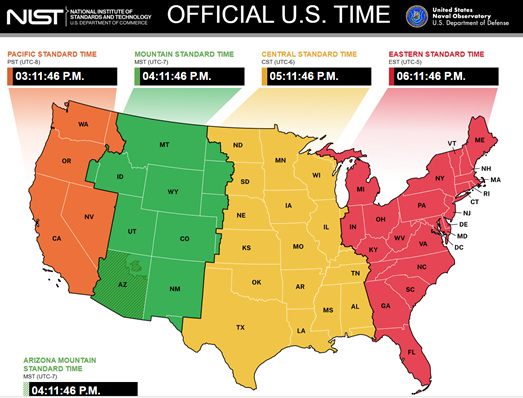
Focus in on the Eastern Time zone and you’ll notice that the region stretches between the eastern edge of Maine and the western edge of the Upper Peninsula of Michigan. But let’s confine ourselves to just the contiguous states and allow the Yoopers to be left alone for another discussion. After a few simple prompts one can find that the eastern most town, city, or village is Eastport, Maine at a longitude of 67°W and that the westernmost town, city or village of Indiana is Mount Vernon at a longitude of 86.5°W. Those longitudes are separated by nearly 20 full degrees, meaning that the sun, which moves from our perception on the Earth 15° per hour, sets over an hour and 20 minutes earlier Eastport that it does in Mount Vernon. And yet we worry about including a leap second to precisely (to within a half of a second) get the Sun at its zenith at noon in Greenwich. We spend an enormous amount of effort putting that bloody little leap second in for the benefit of almost nobody, regardless of how wonderful the discoveries are of the astronomical community. Now on to the columns.
One of the classic problems of symbolic artificial intelligence is trying to get a computer system to navigate through mathematical expressions the way a human can. Despite the fact that many of us groaned when we were in 7th or 8th grade and first learning algebra and that lots of people believe they’re simply bad at math, human beings have a wonderful faculty for seeing patterns and equating things that may on the surface not look the same, and rearranging terms within an equation. This month’s Aristotle2Digital tries to explore what it takes to implement the computer algebra system SymPy (part of the Python ecosystem) so that it is able to work with even a fraction of the facility that a human being does.
Each New Years, millions of people make resolutions: lose weight, date more, do something that scares you each day, and so on. Well, this year it seemed that it might be interesting and profitable to work through an entire book of finance and see what lessons about time and money are contained. This month’s CommonCents starts a year-long exploration through Finance: A Quantitative Introduction by Nico van der Wijst. As with any resolution, we’ll just have to wait to see where it ends.
One of the most impressive machines of scientific discovery that has ever been made is the James Webb Space Telescope (JWST). JWST is a marvel of scientific and engineering know-how and part of its ‘magic’ is the fact that it orbits around an empty point in space so-called around the L2 liberation point of the Sun Earth moon system. This month’s UndertheHood continues its investigation into the circular restricted three-body problem which is the theoretical underpinning for how JWST floats around nothing.
Enjoy.